

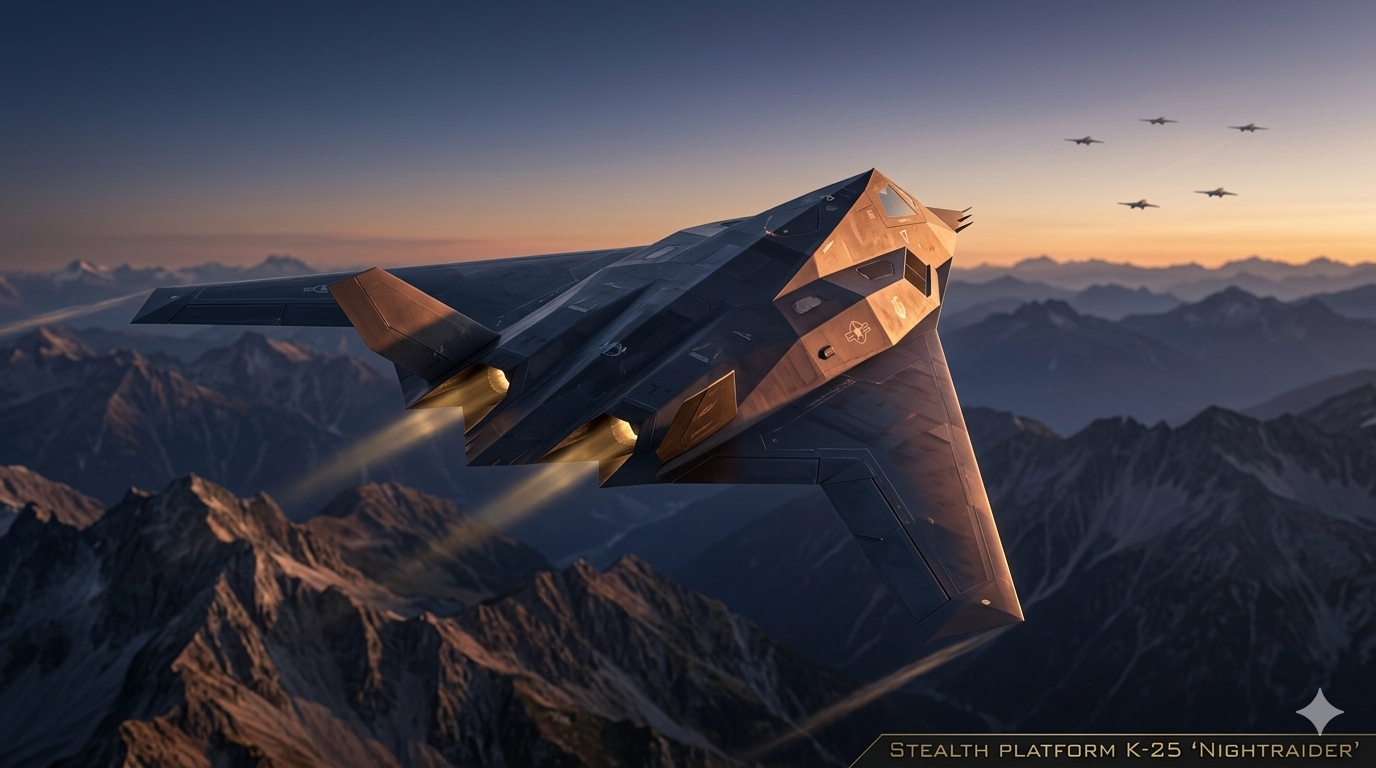
From First Stealth Strike to Next‑Gen Strategic Bomber
The story of stealth aviation begins with an icon and continues with its latest evolution. The F‑117 Nighthawk pioneered stealth technology in combat, reshaping how air forces think about radar, survivability, and precision strikes. Decades later the B‑21 Raider is poised to carry that legacy forward as the backbone of future U.S. strategic bomber capability, building on lessons learned and applying next‑generation design, networking, and weapons flexibility. (Wikipedia)
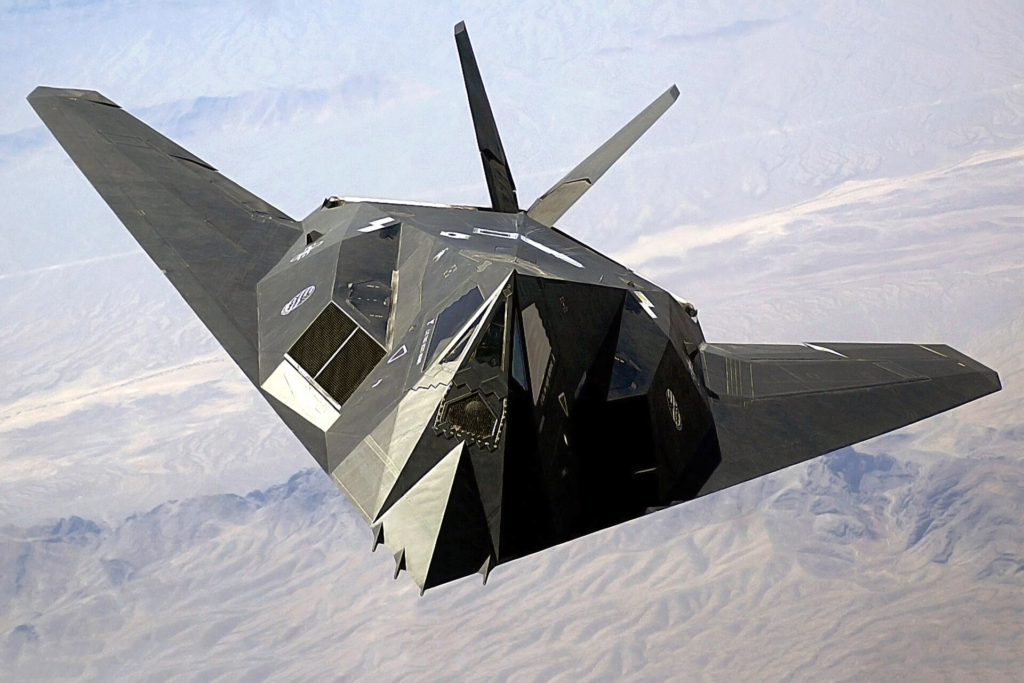
Staff Sgt. Aaron Allmon II – http://www.defenselink.mil/
Origins of Stealth: The F‑117 Nighthawk
The Lockheed F‑117 Nighthawk was a product of Cold War urgency and innovation. Developed by Lockheed’s famed Skunk Works division beginning in the 1970s, it became the first operational aircraft designed around stealth principles — stealth defined here as minimal detectability on radar. Its first flight took place in 1981, and it entered service in 1983, marking a radical departure from traditional aerodynamic design and air combat doctrine. (Wikipedia)
Stealth for the F‑117 was not just an add‑on. The aircraft’s entire shape — angular, faceted surfaces — was crafted to scatter and deflect radar emissions instead of reflecting them. That concept itself stemmed from theoretical work on radar cross‑section (RCS) reduction, which showed even large aircraft could be “invisible” if shaped and coated properly. The Nighthawk’s airframe minimized radar reflections and used radar‑absorbent materials to further reduce its RCS. (Wikipedia)
Operationally, the F‑117 was a single‑seat attack aircraft, optimized for ground target strikes. Unlike a fighter, it lacked advanced air‑to‑air combat systems and onboard guns. Its primary mission was to penetrate enemy airspace undetected and strike high‑value targets, such as radar installations, command centers, and air defenses. All weapons were carried internally to preserve stealth, typically consisting of precision laser‑guided bombs. (Wikipedia)
The aircraft flew under strict secrecy initially, with the U.S. Air Force denying its existence until 1988. It made its combat debut in the 1989 invasion of Panama, but it was the 1991 Gulf War that cemented its reputation. F‑117s flew hundreds of missions deep into Iraqi airspace, striking heavily defended positions with precision and suffering no battle damage. Its performance demonstrated stealth technology’s potential to change the dynamics of aerial warfare. (Wikipedia)
Despite its strengths, the F‑117 had limitations. It was subsonic, unarmed in air‑to‑air combat, and relied on external aerial refueling for extended missions. In 1999, a single F‑117 was shot down during the NATO bombing of Yugoslavia — the first stealth aircraft loss in history — illustrating that even advanced stealth is not invulnerable if opponents exploit gaps in tactics or technology. (Wikipedia)
By the 2000s, newer aircraft with advanced sensors and multirole capabilities, like the F‑22 and F‑35, began to eclipse the F‑117. The Nighthawk was retired in 2008, but its legacy remains fundamental to all modern stealth design. (Wikipedia)
The Next Chapter: B‑21 Raider
The B‑21 Raider is the U.S. Air Force’s answer to 21st‑century threats. It emerged from the Long Range Strike Bomber (LRS‑B) program, initiated in 2011, with the explicit goal of developing a stealthy intercontinental strategic bomber capable of delivering both nuclear and conventional weapons. Northrop Grumman won the contract in 2015, and the B‑21 officially took flight in November 2023, with entry into service expected in the mid‑2020s. (Wikipedia)
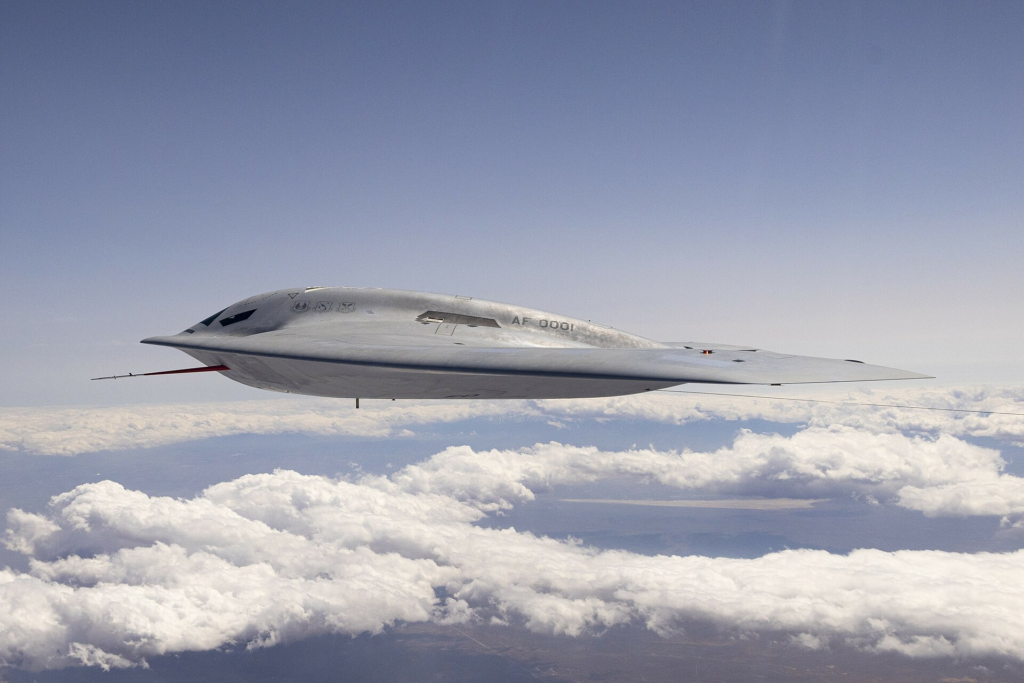
USAF – https://www.dvidshub.net/image/8423170/b-21-raider-continues-flight-test-production
Unlike the F‑117’s strike‑attack focus, the B‑21 is designed for long‑range global reach and deterrence. Its role is primarily that of a strategic bomber — part of the United States’ nuclear triad — with the ability to penetrate sophisticated air defenses and deliver payloads anywhere in the world. Its stealth features go beyond radar avoidance, incorporating advanced materials, coatings, and shaping to reduce detection across multiple spectrums. (Wikipedia)
While specific performance figures remain classified, analysts estimate that the B‑21 can conduct intercontinental missions exceeding 6,000 miles without refueling and can receive aerial refueling to extend that range further. This endurance is necessary for strategic operations, especially in contested environments like the Indo‑Pacific. (Defense Feeds)
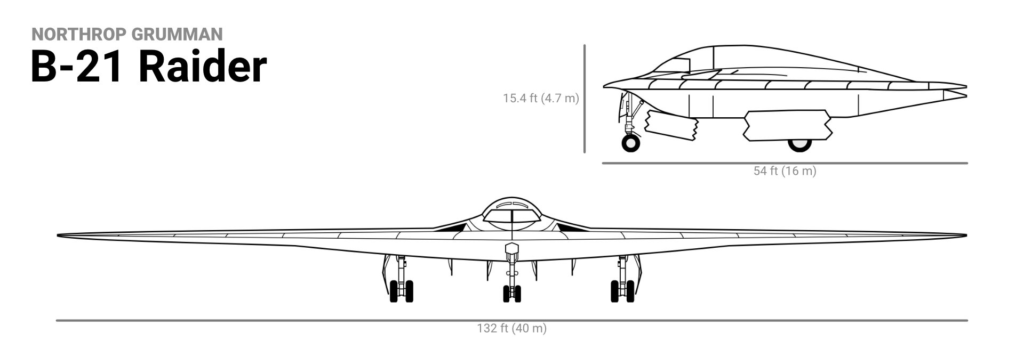
DistractedTurtle – Own work
Front and side profile of the B-21 Raider, based on earlier design studies. It does not fully match the final version.
The B‑21’s design is a sophisticated evolution of stealth. It uses a flying‑wing configuration similar to the B‑2 Spirit but with only two engines and reduced weight. Engine inlets and exhausts are optimized for low observability, and embedded controls further lower signatures. The aircraft’s architecture supports modular upgrades and advanced networked systems, making it adaptable to evolving threats and technologies. (War Wings Daily)
The bomber is built with a digital open architecture. That means it can integrate new software, mission systems, and weapons without major structural changes, ensuring it remains relevant for decades. This approach contrasts with older designs that require extensive and costly retrofits to upgrade avionics or sensors. (Military Update)
Strategically, the B‑21 carries both conventional precision weapons like the AGM‑158 JASSM‑ER cruise missile and nuclear armaments such as the B61 Mod 12 and Mod 13 bombs or the AGM‑181 LRSO strategic missile, giving it flexibility across mission types. It can support deep strike missions, deterrence patrols, and rapid global response missions. (Wikipedia)
Technical and Capability Comparison
Even with differing roles, comparing the F‑117 and B‑21 highlights how far military aviation has progressed in stealth and mission scope:
Stealth & Signature:
• F‑117’s stealth centered on radar cross‑section reduction using faceted surfaces and radar‑absorbent materials — revolutionary for its time.
• B‑21 employs multi‑spectrum stealth with smoother shaping, advanced coatings, and design refinements that extend stealth against modern defenses. (Wikipedia)
Role & Mission:
• The F‑117 was a tactical ground‑attack aircraft, focusing on precision strikes against high‑value targets.
• The B‑21 is a strategic bomber, designed for global reach and deterrence, capable of delivering nuclear and conventional payloads with long endurance. (Wikipedia)
Range & Endurance:
• The F‑117’s range was limited by external refueling and mission radius, suitable for regional conflicts.
• The B‑21’s estimated range exceeds 9,600 km and supports aerial refueling, enabling intercontinental missions. (Defense Feeds)
Survivability & Integration:
• F‑117’s stealth was groundbreaking but worked primarily for radar evasion. Its lack of onboard defensive systems left it vulnerable once detected.
• B‑21 integrates advanced avionics, networked command systems, and robust stealth shaping to operate effectively in contested environments with layered defenses. (Military Update)
Numbers & Sustainment:
• Only 64 F‑117s were built, and the type was retired as newer aircraft emerged.
• The USAF plans to build at least 100 B‑21 Raider bombers, ensuring a modern, sustainable fleet with lower maintenance costs and continuous upgrade paths. (Wikipedia)
Legacy and Future
The F‑117 changed aerial warfare by proving that stealth technology could work in combat. It transformed how air forces approach air defense suppression and precision strikes, and it laid the foundation for all modern low‑observable aircraft. The Raider inherits that legacy and expands it. By blending stealth with reach, payload flexibility, open architecture, and network integration, the B‑21 represents a leap beyond the tactical attack focus of the F‑117 to a holistic strategic deterrent platform suited for modern multi‑domain operations. (Wikipedia)
As air defense systems grow more advanced and the geopolitical landscape shifts, the transition from early stealth pioneers like the F‑117 to next‑generation systems like the B‑21 exemplifies how military technology must evolve. The result is not merely a bigger or faster platform, but a system designed to operate invisibly, strike precisely, and adapt continually — shaping the future of airpower for decades to come. (Military Update)