 11
11
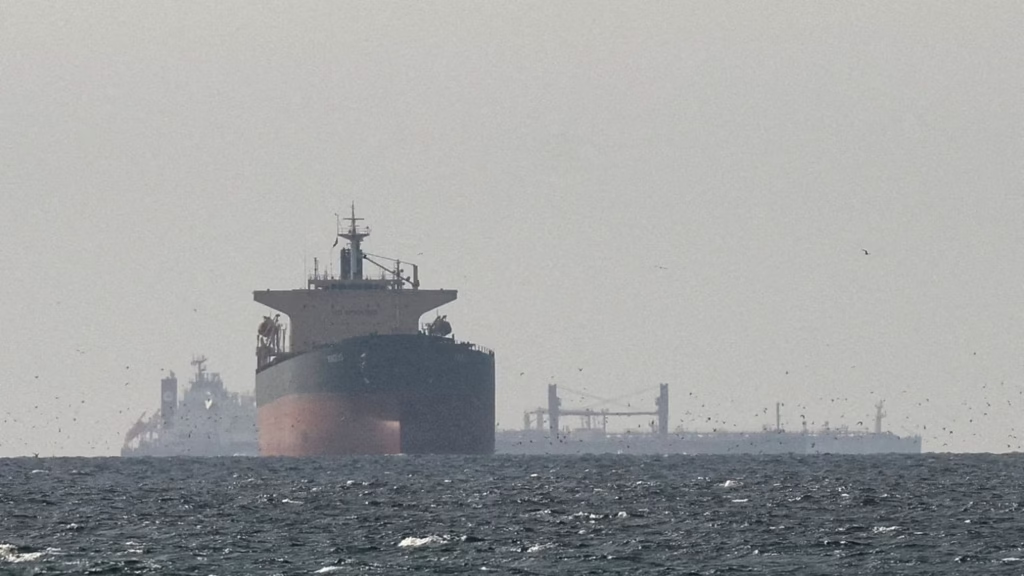
The ongoing tensions involving Iran continue to shape global financial markets, even after a temporary cease-fire. One of the biggest pressure points is the Strait of Hormuz, a critical artery for global oil supply.
Disruptions in this region are now affecting not just shipping but also oil production, creating ripple effects across the global economy. Investors are facing rising uncertainty as energy prices surge, inflation risks increase, and growth forecasts weaken.
In this article, we break down three possible market scenarios for 2026 and what they mean for investors.
The Strait of Hormuz handles nearly a fifth of the world’s oil supply. Any disruption here has immediate global consequences.
According to Morgan Stanley research, oil prices are now expected to average $80 to $90 per barrel in 2026, significantly higher than earlier forecasts.
Energy markets are under stress, and this is feeding into broader economic concerns:
This creates a challenging environment where policymakers must balance inflation control with economic stability.
In this optimistic scenario, tensions ease quickly and shipping through the Strait returns to normal within weeks.
This is often called a “risk-on” environment, where investors shift toward growth-focused assets.
Here, the situation improves slowly, but supply disruptions persist for months.
This scenario creates a high-friction market, where gains are possible but uncertain.
In the most severe case, the Strait of Hormuz remains largely closed for an extended period.
This is a “recession playbook” scenario, where preserving capital becomes the priority.
Regardless of the scenario, a few strategies stand out:
Companies with strong balance sheets and stable earnings perform better in uncertain times.
Spread investments across sectors and asset classes to reduce risk.
Oil prices will remain a key driver of market direction.
Assets like bonds and stable currencies can help protect against volatility.
Even with a cease-fire, the economic impact of the Iran conflict is far from over. The shift from logistical disruptions to production constraints suggests a longer-lasting energy shock.
Markets will continue to react based on:
The Iran conflict highlights how geopolitical risks can quickly reshape global markets. From rising oil prices to shifting investment strategies, 2026 is shaping up to be a year where adaptability is key.
Investors who stay informed, diversify wisely, and adjust to changing conditions will be better positioned to navigate uncertainty and find opportunities.